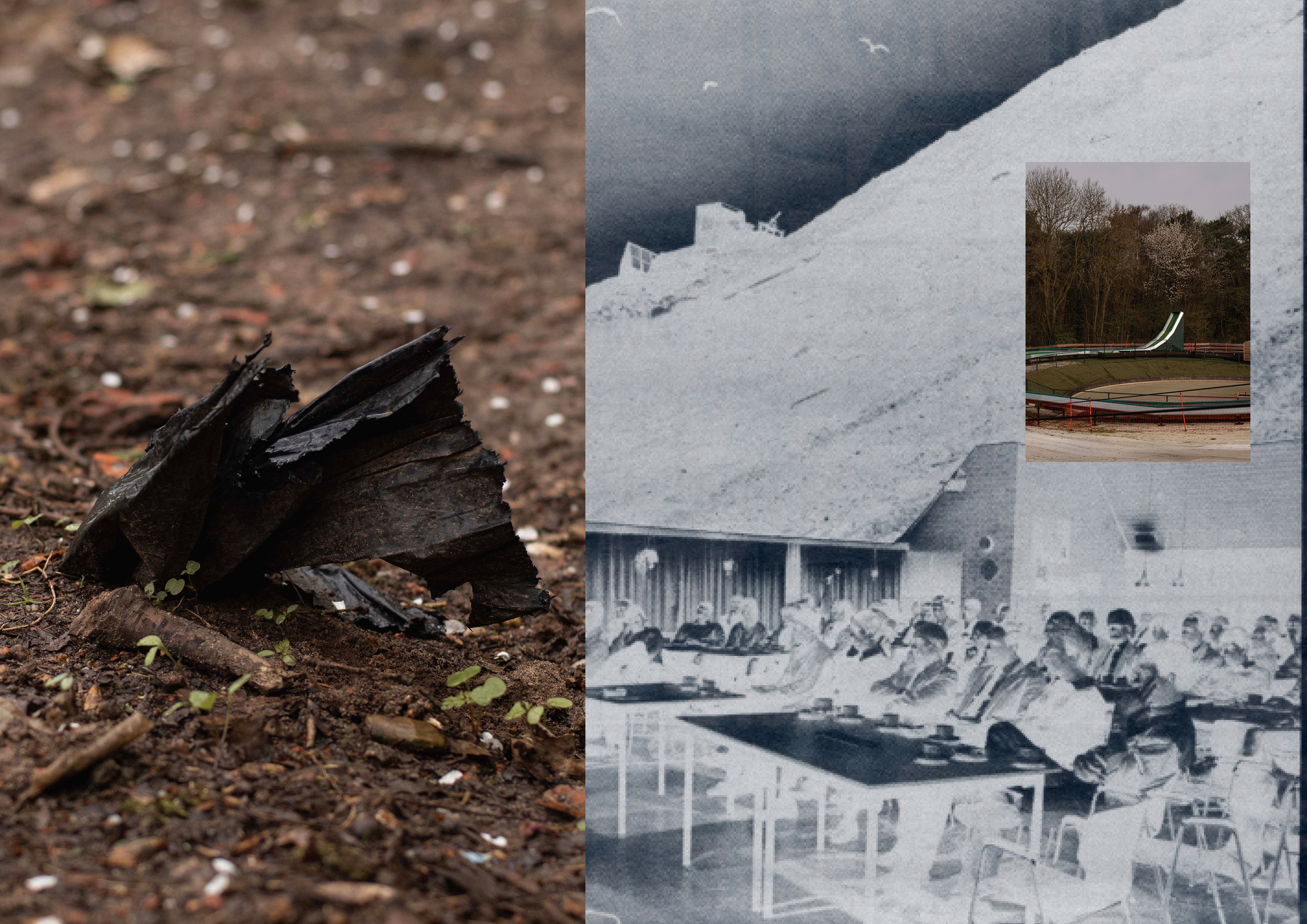
Een flink stuk zwart plastic wappert in het midden van het pad. Een Coca-Cola-dop uit de jaren zestig. Een plastic tas van de plaatselijke videotheek uit de jaren’80. Bomen vallen om omdat ze niet kunnen wortelen.
De opening van de skiberg herinner ik me nog goed. Het is 1988 en het hele dorp loopt uit. Stiekem stop ik kleine witte plastic korrels, die ervoor zorgen dat skiërs moeiteloos de helling afglijden, in mijn zak. Thuis leg ik ze zorgvuldig op de keukentafel. Meer dan dertig jaar later ontdek ik pas wat deze plek ook is: een voormalige vuilstort. De berg werd afgedekt, de skibaan ging open en het afval verdween uit beeld. Langzaam ook uit het geheugen van het dorp. Maar niet uit de grond.
Het is niet meer van elkaar te scheiden wat officieel is gedocumenteerd en wat alleen als gerucht bestaat, wat als recreatie- landschap wordt gepresenteerd en wat daaronder ligt. Ik schuif foto’s en herinneringen over elkaar
De berg gaat nergens heen. Ik ook niet. Ik ben hier opgegroeid, weggegaan en teruggekomen. Het verstoort het geheugen. De berg leek iets, bleek iets anders, en ik geef haar opnieuw een plek in de geschiedenis van het dorp, en in de mijne.
[De berg die niemand ziet, uit De plek bestaat, niet zoals ik dacht, 2025 - nu]
[De berg die niemand ziet, uit De plek bestaat, niet zoals ik dacht, 2025 - nu]
A large piece of black plastic flaps in the middle of the path. A Coca-Cola bottle cap from the sixties. A plastic bag from the local video store from the '80s. Trees fall over because they cannot take root.
I still remember the opening of the ski slope well. It is 1988, and the whole village turns out. Secretly, I put small white plastic pellets, which help skiers glide effortlessly down the slope, into my pocket. At home, I lay them carefully on the kitchen table. More than thirty years later, I discover what this place also is: a former landfill. The hill was covered over, the ski slope opened, and the waste disappeared from view. Slowly, it also disappeared from the village's memory. But not from the ground.
It can no longer be separated: what is officially documented and what exists only as rumor, what is presented as a recreational landscape and what lies beneath it. I layer photographs and memories over one another.
The hill goes nowhere. Neither do I. I grew up here, left, and came back. It disrupts memory. The hill seemed one thing, turned out to be another, and I give it a place once more — in the history of the village, and in my own.
[The Hill Nobody Sees, from The Place Exists, Not as I Thought, 2025 - now]
[The Hill Nobody Sees, from The Place Exists, Not as I Thought, 2025 - now]